 pick a feature
User Feedback Widget for Mobile Apps: Best Options in 2026
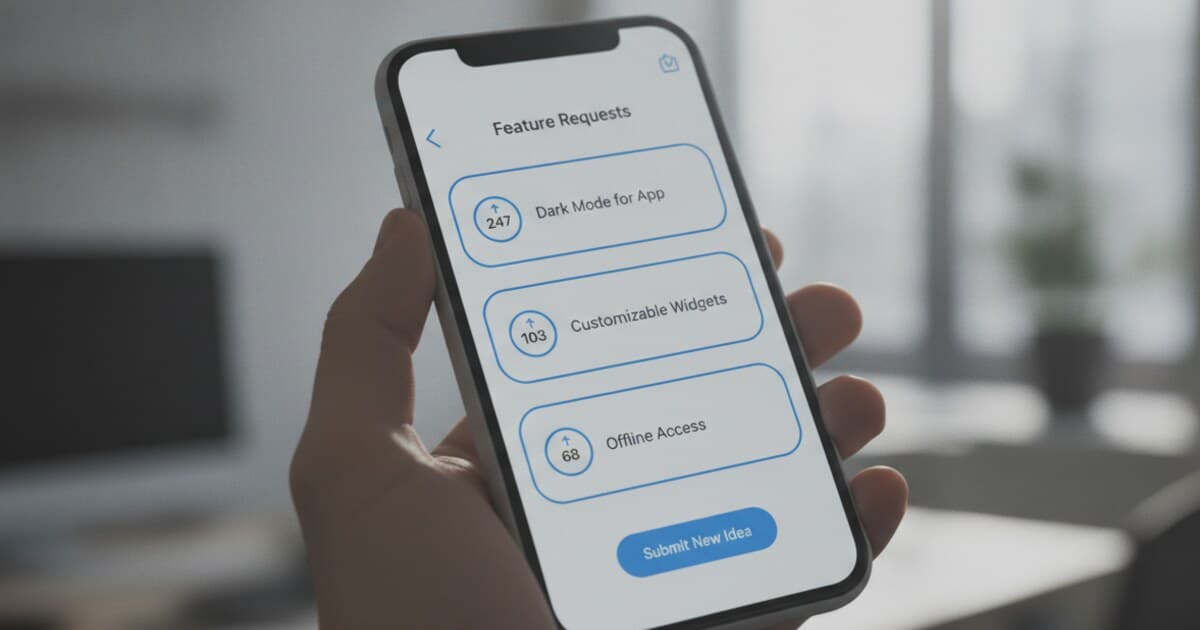
Searching "user feedback widget for mobile apps" returns a mix of survey tools, bug reporters, and feature-request boards, often in the same listicle. For a Flutter dev trying to ship something real, that's not helpful. The three categories solve completely different problems, and picking the wrong one wastes integration time and gives you data you don't actually need.
A survey widget that fires NPS prompts won't tell you what to build next. A feature-request voting board won't capture crash logs. Separating the three categories first cuts the decision from a 25-tool comparison down to two or three real candidates for your actual situation.
The best user feedback widget for mobile apps depends on what you're collecting. For feature request voting, pick a feature is the only Flutter-native SDK with drop-in widgets and a built-in voting and status system, starting free. For in-app surveys, Wiredash and Zonka Feedback work natively in Flutter. For bug reporting and crash capture, Luciq is the mobile specialist.
Three Types of Mobile Feedback Widgets
Most developers searching for a "user feedback widget" actually need one of three things, and the tools built for each category are almost entirely separate products.
Feature request voting gives users a queue to submit ideas and upvote what matters most to them. The output is a ranked list of what to build. Tools: pick a feature, suggest_a_feature.
In-app surveys and NPS capture how users feel right now: satisfaction scores, churn signals, quick pulse checks after key actions. Tools: Wiredash (survey mode), Survicate, Zonka Feedback, Refiner.
Bug reporting and crash capture grab screenshots, device logs, network traces, and session replays when something breaks. Tools: Luciq (formerly Instabug), Shake SDK.
Indie Flutter devs usually need feature request voting first. Knowing which feature to ship next is more urgent than measuring NPS for an app still finding product-market fit. The market for dedicated Flutter feedback SDKs is small but well-defined: as of mid-2026, the main managed options are pick a feature ($0, $5, or $15 per month) and Wiredash (free up to 100k MAU). General survey platforms like Survicate and Zonka Feedback offer Flutter support, but they're priced for product and CX teams running multi-channel research programs, which makes them hard to justify for a bootstrapped solo app. Luciq wraps feature requests into a broader enterprise mobile SDK with crash reporting, session replay, and bug capture, a much larger scope for teams that need all of that together. Self-hosted options like suggest_a_feature exist as a Flutter package, but they require the developer to wire up a Firestore backend, which moves the infrastructure work back onto the team.
Best Feature Request Widget for Flutter Apps
pick a feature is the clearest choice for Flutter devs who want in-app feature request voting without building anything from scratch.
Setup is a single call:
await PickAFeature.initialize(apiKey: 'your_api_key');
Three widget modes are ready to use: full screen (PickAFeatureScreen), dialog (PickAFeature.showDialog), and bottom sheet (PickAFeature.showBottomSheet). Each one drops into your nav flow in a few lines. Users can submit feature requests, upvote existing ones (one vote per device), and leave comments. The dashboard tracks each request through a six-step workflow: pending, under review, approved, in progress, planned, and completed. Only approved and completed requests appear in the in-app widget by default, which keeps the list clean and actionable.
Anonymous users aren't a problem. The SDK generates a device UUID via shared_preferences when a user hasn't signed in, so voting works even in apps with no auth system. For signed-in users, you can attach email, name, a custom ID, or a revenue tier using the updateUser call, which lets you filter feedback in the dashboard by user segment.
Theming is one config object: primary color, secondary color, background color, text color, border radius, and custom copy for every label and button. Demo mode serves canned data locally so you can build and screenshot the widget without hitting the API during development.
Pricing is where pick a feature separates from every web-native competitor. The free tier is real: 1 project, 10 feature requests, no card required. Starter is $5/mo for 3 projects, unlimited requests, user comments, full analytics, and no watermark. Unlimited is $15/mo. For reference, Canny Pro starts at $79/mo and Featurebase Growth runs $29 per seat per month. The price difference is deliberate: pick a feature is built around the assumption that an indie dev is paying out of pocket.
Wiredash is a solid Flutter-native alternative if you want surveys rather than feature request voting. It's free up to 100k MAU and covers NPS, in-app surveys, and screenshot-annotation feedback. There's no voting queue or status workflow. Many Flutter devs run both: Wiredash for NPS pulse checks, pick a feature for feature prioritization. Together they stay under $10/mo and cover the two most useful feedback loops.
suggest_a_feature is a pub.dev package that handles the Flutter UI side but requires you to provision a Firestore backend and write the data layer. A good fit if you want full data ownership and your team has the engineering time to spare. If shipping this week is the priority, the backend setup time is a real cost.
For a detailed Flutter SDK comparison across pick a feature, Wiredash, suggest_a_feature, and Luciq, see the Flutter feature request widget guide.
Best In-App Survey Widget for Mobile Apps
If your goal is NPS measurement, churn risk detection, or structured user research at scale, the survey-oriented tools are built for this use case.
Wiredash covers Flutter natively with promoter and detractor prompts, screenshot-annotation feedback, and in-app survey flows. The integration is clean and well-documented. Its free tier handles most indie apps without hitting limits, which makes it the default starting point for Flutter NPS.
Zonka Feedback supports Flutter with its mobile SDK alongside web and email channels. You can trigger surveys after specific in-app events: app open, purchase completion, session length, or custom events you define. Useful for product teams doing behavioral targeting across a multi-channel program.
Survicate targets SaaS product teams doing continuous in-app research. Strong integrations with Amplitude, Mixpanel, and HubSpot let you tie survey responses to product usage data directly. The mobile SDK works cross-platform. Pricing reflects the enterprise-facing positioning, so it's harder to justify as a solo founder.
Refiner focuses on micro-surveys for SaaS products, with cohort-level NPS tracking and retention analytics. Useful when you're tying satisfaction trends to activation and churned-user data.
For a broader cross-platform view of this category, the in-app feedback widget comparison covers web and mobile options side by side.
Best Bug Reporting Widget for Mobile Apps
Luciq (formerly Instabug) is the dominant tool in this category for mobile. Users shake their device to trigger a bug report. The SDK captures a screenshot, lets the user annotate it, and sends the submission with device info, OS version, network logs, and a session replay of the last 30 seconds of activity. SDKs cover Flutter, React Native, Swift, and Kotlin. Luciq also bundles a feature request module as part of its enterprise package, but that scope and pricing make it a poor fit if feature voting is all you need.
Shake SDK is worth evaluating for Flutter teams that need bug reporting at a more indie-accessible price. It supports the shake-to-report gesture, screenshot annotation, and a basic ticket dashboard. A reasonable middle ground between "build it yourself" and Luciq's enterprise tier.
For teams that want bug reporting alongside feature request voting, running Luciq and pick a feature side by side is a common pattern: Luciq for crash and bug intelligence, pick a feature for the feature queue. Both support Flutter.
How to Choose the Right Feedback Widget
Match the tool to the problem your app actually has right now:
- Want to know what users want you to build next: pick a feature (Flutter SDK, free to start, no backend required)
- Want NPS scores and in-app survey responses: Wiredash (Flutter-native, free tier) or Survicate (multi-channel, team-priced)
- Want crash reports, session replay, and bug screenshots: Luciq (enterprise mobile SDK with Flutter support)
- Want screenshot-annotation feedback alongside NPS: Wiredash or Luciq
- Building on React Native rather than Flutter: Luciq, Survicate, and Zonka Feedback all support React Native; pick a feature's React Native SDK is on the roadmap but not yet live
Most indie Flutter apps do well starting with pick a feature for feature requests and Wiredash for NPS. Under $10/mo combined, Flutter-native on both sides, and each installs in an afternoon. Compare that to designing and building a voting UI, a Firestore schema, a moderation dashboard, and an NPS trigger system from scratch: realistically 80 to 120 dev hours before it's production-ready.
For teams scaling past the indie tier with budgets for behavioral targeting, multi-channel research, and deep analytics integrations, Survicate and Zonka Feedback are the natural next step.
If you're also evaluating options from the best Flutter feedback SDK roundup, the decision tree above narrows that list down to what actually matters for your specific feedback use case.
pick a feature is a Flutter SDK that drops a feature request widget into your mobile app with a single initialization call. Users submit ideas, upvote what matters, and your dashboard tracks each request through a six-step status workflow. Start free at pickafeature.com. No card required, takes about 15 minutes to install.