 pick a feature
Public Roadmap Tool: Best Options for Indie Teams in 2026
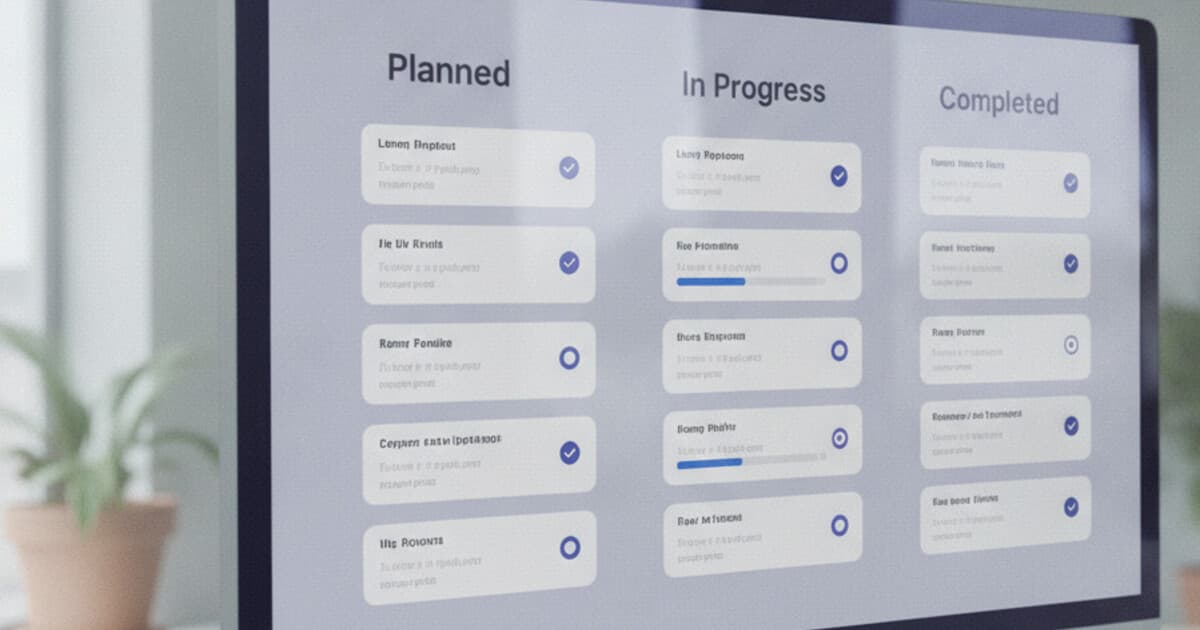
Picking a public roadmap tool seems simple until you compare five different options with five different pricing structures. Some tools charge per seat. Some cap how many ideas you can track. Some require you to run your own server.
The market has grown a lot since Canny established the category. You've got hosted SaaS options at various price points, open-source alternatives you self-host, and a newer category of in-app SDKs for mobile teams. The right choice depends on your audience, your budget, and how much maintenance you're willing to handle.
This guide covers the 5 best public roadmap tools in 2026 with concrete pricing and the honest version of their trade-offs.
The best public roadmap tools in 2026 are Canny ($79/mo), Featurebase ($29/seat/mo), Frill ($25/mo for up to 50 ideas), Astuto (free to self-host), and Fider (open source). For bootstrapped indie teams, Frill or Astuto offer the best value. If you're building a Flutter app and want in-app voting rather than a web portal, pick a feature starts at $5/month.
What Is a Public Roadmap Tool?
A public roadmap tool gives your users a visible window into your feature pipeline. They visit a URL (typically a subdomain like feedback.yourapp.com) and see what's being planned, what's in progress, and what just shipped. Most tools let users submit new ideas and upvote existing ones.
This is different from a private backlog. A private backlog lives in your project management tool and is only visible to your team. A public roadmap is customer-facing, and it serves two purposes: collecting feedback at scale and showing users that you're building with them, not just for them.
Before picking a tool, thinking through how to collect feature requests in a structured way matters. A public board changes the behavior of your user feedback loop significantly.
Public roadmap tools fall into 3 categories based on how they work. Hosted SaaS products like Canny and Featurebase manage infrastructure for you, charging a monthly fee from $25 to $79. Open-source platforms like Astuto and Fider let you self-host for free, though you'll pay $5-20/month for a VPS to run them.
In-app feedback SDKs like pick a feature put the request board inside your product, skipping the public web portal entirely. Each category carries a different trade-off: hosted SaaS is live in under 10 minutes, while self-hosted gives you full data control and lower costs over 12+ months.
For most indie hackers, the key factor is where their users spend time. Web-first apps tend to see more engagement from a standalone public portal. Mobile apps typically see higher submission rates when the feedback board lives inside the product, where users already are.
The 5 Best Public Roadmap Tools in 2026
Canny
Canny is the market leader. It's been around since 2016 and has the most integrations (Jira, Linear, GitHub, Intercom, Zendesk), the most polished UI, and the widest brand recognition in the feature request category.
Pricing starts at $79/month for the Pro plan. That covers unlimited features, custom branding, integrations, and a changelog. There's a free plan, but it doesn't include a public roadmap; it's more of a way to test the product before committing.
Best for: Mid-market and growth-stage SaaS teams where $79/month is an acceptable tool cost and integrations with existing project management tools matter.
Skip it if: You're an indie hacker paying out of pocket. $79/month is steep when you're bootstrapping.
Featurebase
Featurebase positions itself as the modern Canny alternative. The interface is cleaner, the setup is faster, and it ships new features frequently. It includes a public feedback board, an in-app widget, a changelog, and email digests.
Pricing is per-seat at $29/seat/month on the Growth plan. For a solo founder, that's $29/month. For a 3-person team, that's $87/month, which actually surpasses Canny. Keep that math in mind as you scale.
Best for: Solo founders and 2-person teams who want a polished, full-featured public roadmap and prefer Featurebase's UI to Canny's.
Skip it if: You're on a team of 4 or more, where per-seat costs climb fast.
Frill
Frill aims to be the simplest option in the space. Clean design, quick setup, a public roadmap page you can brand with your colors. Nothing superfluous.
The Startup plan costs $25/month and caps at 50 ideas. That's a real constraint: if your users are active submitters, you'll hit the cap fast. The Growth plan removes it, but jumps to a significantly higher price point.
Best for: Early-stage indie products that need a public feedback board now and have fewer than 50 active feature requests at any given time.
Skip it if: Your users submit a lot. Hitting the 50-idea cap mid-sprint is disruptive.
Astuto
Astuto is an open-source feature request board built with Ruby on Rails. You self-host it on a VPS, which means the software itself is free; you pay $5-20/month depending on your hosting provider.
The feature set is solid: multiple boards, voting, comments, a status workflow, and a public-facing board your users can access. Since it's open source, you own your data completely and can modify the code if needed.
Best for: Founders who want full data control, are comfortable with a server setup, and want to keep long-term costs low.
Skip it if: You don't want to manage infrastructure. Astuto requires occasional maintenance.
Fider
Fider is another open-source option, written in Go. It's lighter than Astuto and opinionated in a straightforward way: everything is public by default. Users visit your board and see all submitted ideas with vote counts and statuses.
Setup is fast if you're comfortable with Docker. Hosting costs are similar to Astuto. Fider has fewer admin controls and a simpler status workflow than Astuto, but it loads quickly and stays out of the way.
Best for: Solo founders and very small teams who want the simplest possible self-hosted public board with zero configuration overhead.
Skip it if: You need detailed moderation controls or a complex status workflow.
Public Roadmap vs. In-App Voting: Which One Do You Need?
A public roadmap lives on a separate web URL. Your users open a browser, navigate to feedback.yourapp.com, and interact there. That works well for web-first products where users are already accustomed to visiting your site.
For mobile apps, the story is different. Most users skip the separate feedback portal and stay in your app. If feedback collection happens outside the app, you'll get fewer submissions from the most engaged users.
In-app voting captures feedback where users actually are. When someone runs into a missing feature, they can submit a request without leaving the product. That friction reduction matters for feature request management at scale.
If your product lives entirely on the web, a public roadmap tool is probably the right call. If you're building a mobile app, an in-app SDK might capture more total feedback with less user effort on their end.
Public roadmaps and in-app voting can coexist. Some teams run both: a public board for their web users and an in-app widget for their mobile users. The cost adds up, though, so most indie teams pick one approach based on where most of their users are.
How pick a feature Fits Into Your Feedback Stack
pick a feature takes the in-app route. It's a Flutter SDK that drops a feature request board directly into your app. Users submit ideas, upvote existing ones, and see status updates without leaving the product. The feature request voting mechanics are all built in.
The trade-off is clear: there's no shareable public URL for your roadmap. Users can't browse your feedback board outside the app or send a link to a friend. If that's a hard requirement, pick a feature isn't the right fit, and Frill or Astuto will serve you better.
Where it does work well: Flutter apps with engaged users who spend time inside the product. Setup is one line of code. Three drop-in widgets (full screen, dialog, bottom sheet) cover most UI patterns without any custom work. The status workflow (pending, under review, approved, in progress, planned, completed) gives users visibility into what's happening with their requests.
Pricing is built around indie budgets. The free tier is genuine: 1 project, 10 feature requests, no credit card required. The Starter plan is $5/month for 3 projects and unlimited requests. The Unlimited plan is $15/month for everything. That puts pick a feature at 1/5th the cost of Frill and roughly 1/15th the cost of Canny.
Frequently Asked Questions
What is a public roadmap tool?
A public roadmap tool hosts a visible board of your product's feature pipeline. Users visit a URL and see what's planned, in progress, and completed. Most tools let users submit requests and vote on priorities, giving teams a structured way to collect feedback and show users they're listening.
Is there a free public roadmap tool?
Yes. Astuto and Fider are open-source platforms you can self-host for free. You'll pay around $5-20/month for a VPS, but the software itself costs nothing. Canny has a free plan but it doesn't include a public roadmap. Frill offers a free trial but requires a paid plan for ongoing use.
Do I need a public roadmap or just in-app voting?
It depends on where your users spend time. A public roadmap works well for web apps where users visit your marketing site or docs. For mobile apps, in-app voting captures more feedback because users see it where they're most active. Flutter developers often prefer an in-app SDK over a separate web portal.
What's the cheapest paid public roadmap tool?
Frill starts at $25/month with a cap of 50 ideas, making it one of the most affordable paid options. Featurebase starts at $29/seat/month. Canny's paid tier starts at $79/month. For self-hosted solutions, Astuto and Fider are free beyond hosting costs.
Can pick a feature display a public roadmap?
pick a feature is built around in-app voting for Flutter apps. Users submit and vote on feature requests inside the app itself. There's no shareable public web URL for a roadmap board. If you need a publicly accessible roadmap page, Frill, Astuto, or Featurebase are better fits.
For Flutter apps specifically, pick a feature gives you in-app voting, upvoting, and status tracking at $5/month with one line of setup code. Start free at pickafeature.com.