 pick a feature
How to Collect Feature Requests: A Practical Guide
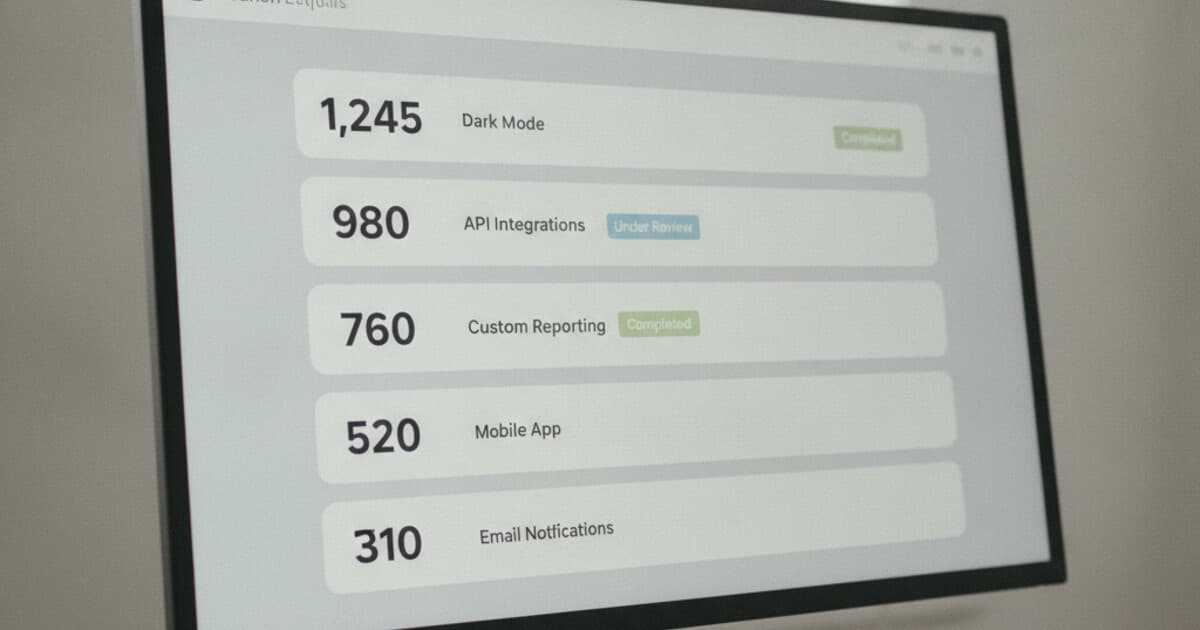
Your users have opinions about your app. Getting those opinions from their heads into your roadmap is harder than it sounds. Most teams start with email or a shared Notion doc, realize neither scales, and then bounce between tools looking for something that sticks. This guide covers how to collect feature requests systematically so the data you gather is actually useful when you sit down to plan your next sprint.
To collect feature requests effectively, give users a single frictionless place to submit ideas and upvote existing ones. The best approach puts a voting board inside your app, pairs it with moderation to filter noise, and uses a status workflow to close the loop with users whose ideas you ship.
Why Most Teams Lose Good Feature Requests
Most teams don't have a system. They have a pile.
Requests come in through support tickets, app store reviews, Twitter DMs, sales calls, and the occasional email to the founder. Each one lives in a different tool, owned by a different person, with no connection to the roadmap.
Scatter is the problem. When requests live in 6 places, you can't measure demand across them, prioritize by votes, or close the loop when you ship. Users who took the time to give feedback never hear back, so they stop.
Centralizing how you collect feature requests changes the quality of data you work with. When every request flows through the same channel, you measure demand objectively: a request with 40 upvotes outweighs one with 5 regardless of who submitted it, which strips out the loud-customer bias that plagues most informal systems. You also get requests in a consistent format (title, description, optional email) instead of sifting through app store reviews and DMs trying to extract signal from unstructured text. Product teams that use a dedicated request channel and then close the loop with status updates see meaningful gains in user trust. Users who see their request move from "pending" to "completed" are more likely to submit more requests, leave a positive review, and recommend the product to others. The compounding effect: engaged users generate better data, which produces better roadmap decisions, which builds more trust, which generates more engaged users.
How to Collect Feature Requests In-App
The highest-quality requests come from users in the middle of using your app.
They've just hit a limitation or spotted something missing. The friction of switching to email kills most of that feedback before it reaches you. An in-app widget removes that friction entirely.
A feature request widget that opens from a button in your app's menu puts the submission form right where the user already is. They type their idea, optionally leave an email, and submit in under 30 seconds. There's no account creation and no redirect to an external portal.
The widget also shows existing requests, so users can upvote instead of submitting a duplicate. This matters more than it sounds: 60-80% of requests a team receives are variants of the same 5-10 underlying ideas. Upvotes collapse those variants into measurable demand. Instead of "we got 20 requests about X," you get "X has 47 upvotes from 47 separate users." That's a much cleaner signal.
For Flutter apps, the in-app feedback setup guide covers the technical implementation in detail, including widget placement and theming options.
Other Ways to Collect Feature Requests
In-app collection captures requests from active users. You'll miss users who churn before opening the feedback widget, and you'll miss potential users who haven't downloaded yet.
A few other channels worth checking on a regular cadence:
App store reviews. Read them weekly. They're unstructured, but recurring themes surface quickly. Someone writing "I wish this app could X" is a feature request with zero submission friction on their end.
Support conversations. Users who contact support often describe what they needed but couldn't do. Route those insights to your request board rather than letting them die in an inbox thread.
User interviews. 30-minute calls with active users surface requests that people wouldn't bother to type. Especially useful in the early days when your user base is small enough to talk to personally.
The goal isn't to route everything through one form. It's to have one place where requests land after collection, regardless of where they came from. You bring the signal to the board; the board handles the rest.
How to Manage Feature Requests Once You Collect Them
Collecting requests is only half the system. The other half is managing them so the data stays useful.
Three things to do once requests start coming in:
Moderate regularly. Approve requests that are actionable and on-topic. Reject or archive noise: vague submissions, off-topic ideas, and clear duplicates. Merge duplicate entries into one so their upvotes add up rather than split.
Update statuses as you work. A status workflow (pending, under review, approved, in progress, planned, completed) keeps users informed without requiring you to send individual updates. When a request moves to "in progress," anyone who upvoted it can see it. When it reaches "completed," they know you shipped it.
Close the loop. This is the step most teams skip, and it's the most valuable one. Users who see that their request shipped are more likely to submit future requests. The feedback loop only compounds if it's visibly closed.
The feature request voting guide goes deeper into how voting systems work and which tools handle moderation best.
How to Prioritize What You've Collected
Once you have upvotes and a clean request list, prioritization gets simpler but not automatic.
Start with upvote count as your demand signal. A request with 50 upvotes from 50 separate users is a clear product signal. A request from one vocal user with one vote is anecdote.
Then layer in business factors:
- Does this feature help with acquisition, retention, or monetization?
- Does it fit the direction the product is actually heading?
- Can you ship it in a reasonable timeframe given your team size?
The upvote count tells you what users want. Your judgment tells you what to build next. Both inputs matter, and neither works well without the other.
For context on how different tools surface and organize this data, the best feature request tools in 2026 roundup compares prioritization workflows across the main options.
How pick a feature Handles This for Flutter Apps
pick a feature is a Flutter SDK plus cloud dashboard built for exactly this workflow.
You drop in the SDK with one line of code (PickAFeature.initialize(apiKey: 'your-key')), then choose which widget fits your app's UI: full-screen, dialog, or bottom sheet. Users browse existing requests, upvote, comment, and submit new ones without leaving your app.
On the dashboard side, you moderate submissions, move requests through a 6-stage status workflow (pending, under review, approved, in progress, planned, completed), and see which requests have the most traction. Only approved and completed requests show up in the user-facing widget, so your users see a clean board rather than a dump of every raw submission.
Anonymous users are handled automatically via a device UUID stored in shared preferences, so you don't have to force sign-in to collect votes from people who haven't created accounts.
Pricing starts at free: 1 project, 10 requests, no credit card required. The Starter plan is $5/month for 3 projects with unlimited requests. Compare that to Canny's Pro tier at $79/month or Featurebase Growth at $29/seat/month. pick a feature is priced for indie teams paying out of pocket, where every monthly line item gets scrutinized.
The free tier is genuine: 1 project, 10 feature requests, indefinite. Many indie apps stay on free for the first several months while validating whether users actually engage with the voting board before upgrading.
Frequently Asked Questions
How do I get users to actually submit feature requests?
Make it easy to find and fast to complete. A visible "Suggest a Feature" button in your app's menu or settings handles most of it. The biggest barrier isn't user reluctance to share feedback; it's users not knowing the option exists.
Should I accept anonymous feature requests?
Yes, for most indie apps. Requiring sign-in to submit cuts request volume significantly. Add an optional email field if you want to follow up with specific users, rather than making it required for everyone.
How many feature requests do I need before building something?
Volume isn't the right metric. Look for pattern: the same underlying need appearing from different users in different words. Five to ten upvotes from separate users on one request usually signals real demand worth evaluating against your roadmap.
How do I prioritize feature requests once I have them?
Start with upvote count as a demand signal, then layer in business factors: does this help with acquisition, retention, or revenue? Does it fit your roadmap direction? Demand tells you what users want; your judgment tells you what's worth building.
Do I need a dedicated tool, or can I use a spreadsheet?
Spreadsheets work for the first 20-30 requests. After that, you lose the ability to vote, sort by demand, or show users status updates. A dedicated tool removes a lot of manual overhead, even on a free tier.
pick a feature gives Flutter teams a drop-in way to collect, vote on, and close the loop on feature requests directly inside the app. The free tier covers 1 project and 10 requests with no card required. Visit pickafeature.com to add it to your Flutter app in about 30 minutes.