 pick a feature
Feature Voting Widget: 5 Best Options in 2026
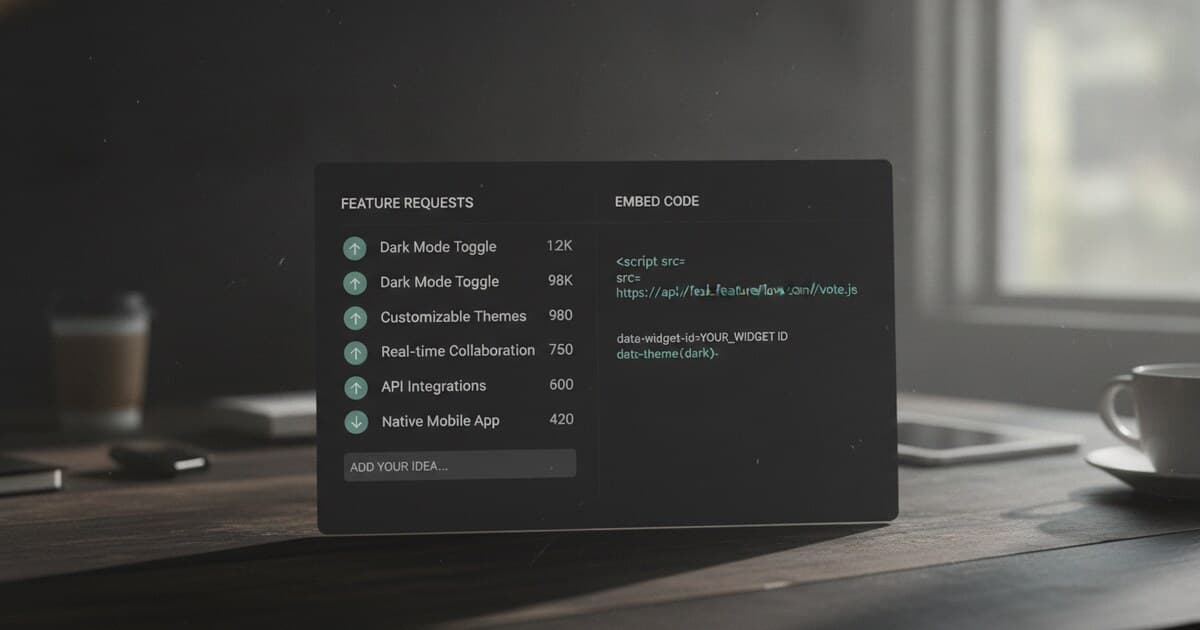
Most feature boards die at a URL nobody bookmarks. Users don't navigate there, don't remember the link, and you end up with five votes in three months wondering whether anyone cares.
A feature voting widget solves the distribution problem. Instead of asking users to visit a separate page, you bring the voting board to them. It embeds in your app, your settings screen, or your marketing site, and votes land where your users already are.
This article compares 5 options: pick a feature, UserJot, Frill, Features.Vote, and VoteFirst. Pricing is verified from live listings. Free tiers are called out honestly, and there's a section on which tools extend to mobile apps.
A feature voting widget is a UI component you embed in your website or app. Users submit and upvote feature requests without leaving your product. For most indie teams, pick a feature ($5/mo, script tag plus Flutter SDK) and UserJot (free tier, 2 boards, unlimited votes) are the strongest starting points. Both set up in under 10 minutes.
What to Look for in a Feature Voting Widget
Five things matter when evaluating a voting widget: embed method, pricing model, free tier quality, mobile support, and whether votes from multiple surfaces merge into one count.
Embed method shapes the day-one experience most. Script tags use Shadow DOM isolation so they don't collide with your site's existing styles. Iframes still work, but scroll and sizing edge cases pile up quickly. Inline embeds render a board inside a specific container on a dedicated page, good for a /roadmap route.
Feature voting widgets can be embedded three ways: script tag (Shadow DOM), iframe, or inline container. The script-tag approach became the standard as Shadow DOM V1 landed across all major browsers: Chrome 53 (2016), Firefox 63 (2018), Safari 10 (2016), Edge 79 (2020). A single tag with a data-api-key attribute handles initialization, CSS isolation, and the floating launcher in one step, replacing the older iframe approach that required manual sizing and scroll handling. Pricing in this category runs flat monthly, not per-user or per-vote, from free up to $49/mo for unlimited ideas. Idea-count caps are the most common gotcha on entry tiers: Frill limits Startup to 50 active ideas at $25/mo, which fills up fast on an active product. For mobile teams, widget support can mean a native Flutter SDK, a native SwiftUI SDK, or a hosted public board opened in an in-app browser. All three approaches can merge votes into the same underlying board.
5 Best Feature Voting Widgets in 2026
1. pick a feature: Best for Flutter + Web
pick a feature ships a web SDK as a single script tag. Drop the one-line snippet from the dashboard onto any page and a floating "Feedback" button appears in the bottom corner. The SDK initializes with your data-api-key attribute and renders in a Shadow DOM, so it won't bleed styles into your existing page.
Three embed modes come out of the box. The floating launcher is the default. Adding data-pickafeature-open to any element opens the widget from a button or link. An inline embed mode using data-container="#your-element" renders the board always-open inside a page section, which works well for a dedicated /suggestions page.
The Flutter SDK uses the same API key and the same project. Web votes and Flutter app votes land in one board with no extra configuration. For React Native, iOS, and Android, the hosted public board at pickafeature.com/b/slug opens in an in-app browser and counts votes on the same board. The web SDK is open source on GitHub (MIT) and available on npm.
Pricing: Free (1 project, 10 requests), $5/mo Starter (3 projects, unlimited requests), $15/mo Unlimited. No credit card required for the free tier.
2. UserJot: Best Free Tier
UserJot's free plan is the most generous here: 2 feedback boards, unlimited posts, unlimited users, a public roadmap, and a changelog at $0. The in-app widget uses a single script tag and shares board data with the standalone portal. Votes from the widget and votes from the public board add up in the same place.
The widget opens a feedback panel inside your product. Users can browse requests, upvote, and submit new ones without going to a separate URL. UserJot doesn't charge per user — you pay a flat rate regardless of how many people vote.
The free tier doesn't include a custom domain or guest posting. Those come with the $29/mo Starter plan. For indie projects testing whether a feedback widget sees real usage, the free tier is enough to answer that question before spending anything.
Pricing: Free (2 boards, unlimited posts/users), $29/mo Starter (custom domain, 5 boards, private boards), $59/mo Professional (unlimited boards, SSO). [Source: userjot.com]
3. Frill: Best for Teams Needing Unlimited Widgets
Frill has a dedicated widget product with one strong differentiator: unlimited widgets on every paid tier. Most tools limit how many widget instances you can create. If you need the same voting board embedded in multiple places (settings page, onboarding flow, help center), Frill doesn't charge extra for it.
There's no free plan. The entry tier is $25/mo (Startup), which caps you at 50 active ideas. On an active product with steady submissions, that cap fills up in a few months and forces you to archive ideas manually to stay under it.
The $49/mo Business plan removes the idea cap and adds 3 surveys. For teams who also want a changelog and roadmap in the same dashboard, Frill bundles all three at a lower price than Featurebase Growth.
Pricing: $25/mo Startup (50-idea cap, unlimited widgets), $49/mo Business (unlimited ideas). 14-day trial, no free plan. [Source: frill.co/pricing]
4. Features.Vote: Best for iOS + Web
Features.Vote targets web apps specifically. The widget embeds on any framework: React, Vue, Next.js, or plain HTML. There's also a native SwiftUI SDK for iOS 16+ and macOS apps, which makes it one of the few tools with genuine native mobile support outside of Flutter.
The entry plan is $9/mo (Lite) for 1 project. The 14-day trial doesn't require a credit card. The $29/mo Growth plan adds unlimited projects, user segmentation, private boards, and a public changelog.
Pricing doesn't scale with votes or voters, which is the right model for indie teams. The floating button is the default embed mode, and customization is available across all tiers.
Pricing: $9/mo Lite (1 project), $29/mo Growth (unlimited projects, user segmentation, custom domain). No credit card for trial. [Source: features.vote/pricing]
5. VoteFirst: Best for Weighted Voting
VoteFirst is built widget-first. Share and embed options are baked into the roadmap interface, and weighted voting ships on every tier. If you want to give paying customers more voting weight than free users without custom code, VoteFirst handles it at the $9/mo entry point.
The Lite plan covers 1 project. The $39/mo Pro tier unlocks unlimited projects, team management, and a custom domain. The trial requires a credit card upfront, which adds more friction to testing it than most alternatives here.
No free tier. No mobile SDK. For web-only teams who specifically need weighted voting at an accessible price, VoteFirst fills that slot.
Pricing: $9/mo Lite (1 project, weighted voting), $39/mo Pro (unlimited projects). 14-day trial, credit card required. [Source: votefirst.app/en/pricing]
Floating Launcher vs Inline Embed vs Iframe
The three embed patterns each suit a different page context.
Floating launcher is the right default for most teams. A persistent button in the corner lets users submit feedback from any page without interrupting their workflow. One attribute controls placement (bottom-right is standard). The board opens in an overlay.
Inline embed makes sense for a dedicated page. If you have a /roadmap or /feedback route, you point a container element at the widget and the board renders always-open without a click. pick a feature, UserJot, and Features.Vote all support this mode.
Iframe is the legacy approach. It still works but CSS isolation is messier, and scroll height edge cases require manual handling. Use it only if your platform blocks custom script tags.
For a deeper look at all three methods with code examples, see How to Embed a Feedback Board on Your Website. For standalone voting apps without a website embed, see Feature Voting App.
Which Feature Voting Widget Should You Choose?
A quick decision guide:
- Building on Flutter: pick a feature (Flutter SDK and web widget share one board)
- iOS-native app: Features.Vote (SwiftUI SDK for iOS 16+)
- Zero budget: UserJot free tier (2 boards, unlimited votes) or pick a feature free tier
- Need unlimited ideas on entry tier: UserJot, Features.Vote, or pick a feature Starter ($5/mo)
- Need unlimited widget instances: Frill (all paid tiers)
- Weighted voting: VoteFirst ($9/mo Lite)
- Idea-volume control + changelog + surveys in one tool: Frill ($49/mo Business)
For a broader look at website embed options, Feature Request Widget for Your Website covers additional tools and use cases.
Frequently Asked Questions
What's the difference between a feature voting widget and a feedback widget?
A feature voting widget focuses on collecting and prioritising feature requests through upvotes. A general feedback widget captures any feedback: bugs, praise, support questions, or NPS scores. If your goal is to build a prioritised backlog from user input, a dedicated voting widget keeps the signal cleaner than a catch-all feedback form.
Can I use a feature voting widget in a mobile app?
Yes, with some variation by tool. pick a feature has a native Flutter SDK. Features.Vote has a SwiftUI SDK for iOS 16+. For React Native, Android, and other platforms, opening a hosted public board in an in-app browser is the standard approach. Votes from mobile users count alongside web votes on the same board.
Do feature voting widgets slow down page load?
Most script-tag widgets load asynchronously with defer, so they don't block your main page render. The initial SDK payload is typically under 30KB. Board data loads only when a user opens the widget, so page metrics aren't affected for users who never click the launcher.
Is there a free feature voting widget?
Pick a feature and UserJot both have genuine permanent free tiers. Pick a feature gives you 1 project and 10 requests. UserJot includes 2 boards, unlimited posts, and unlimited voters with no time limit. Frill, VoteFirst, and Features.Vote all offer 14-day trials but don't have a permanent free option.
If you want a feature voting widget that works on the web and inside a Flutter app from the same dashboard, pick a feature handles both. The web SDK is a single script tag, the Flutter SDK is a pub.dev package, and the free tier is permanent with no credit card required. Start at pickafeature.com.